Come with me on a flight of fancy just for a moment: imagine that the film director Woody Allen had set his film Midnight in Paris in London instead. In what period of British history would Allen have time-travelled to: what moment in time represents London as its most nostalgic? I thought it would be fun to have a go at a British version of the film, so here’s my take of Midnight in London.
For those of you who haven’t seen the Woody Allen romantic comedy, here is a quick synopsis. Screenwriter Gil Pender (Owen Wilson) and his fiancée Inez (Rachel McAdams) are in Paris with Inez’s conservative parents, staying at a lavish hotel and eating in Michelin-star restaurants. Disillusioned Gil is in love with the past and is writing a book about a nostalgia shop. As he wanders around Paris on his own, a mysterious car rolls up towards him at the stroke of midnight, and Gil is whisked back to 1920s Paris to meet a who’s who of the Jazz Age.
Premiere
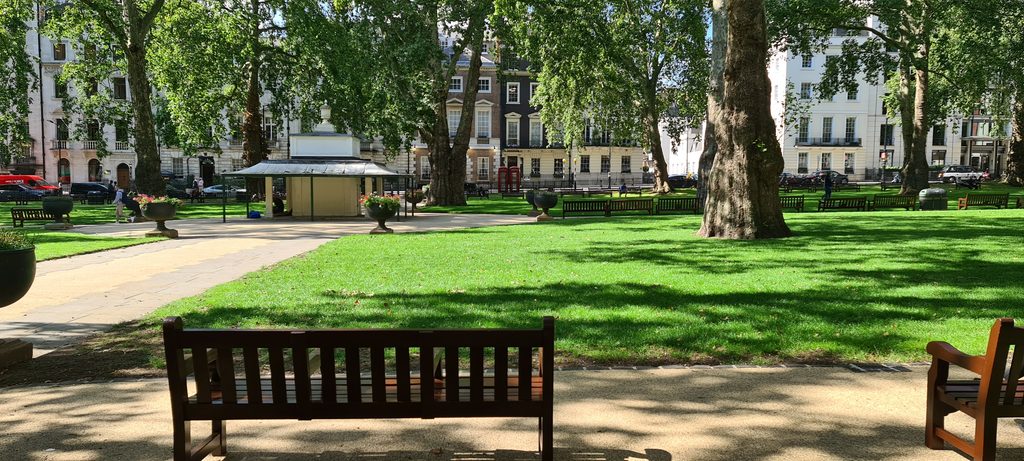
The film opens with a tableau of Parisian street scenes, with Sidney Bechet’s Si tu vois ma mère playing in the background. Our film opens with a montage of London. A Nightingale Sang in Berkeley Square by Leslie “Hutch” Hutchinson plays in the background. Hutch was a darling of the London set and a favourite of the Prince of Wales (later Edward VIII). Listen to it here.
The Bold and the Beautiful
In the film, Gil and Inez visit Giverny, painter Claude Monet’s house, about an hour outside Paris, and Gil starts to fall in love with the romance of Paris.
I’d like to think that Gil would have travelled an hour outside central London to sumptuous Eltham Palace in Greenwich. It wasn’t built by an Impressionist painter, but this Art Deco folly is fantastically wonderful. It’s the sort of place of which Hercule Poirot would approve, and where ghosts of 1930s past are sipping martinis and discussing the impending war with Germany.
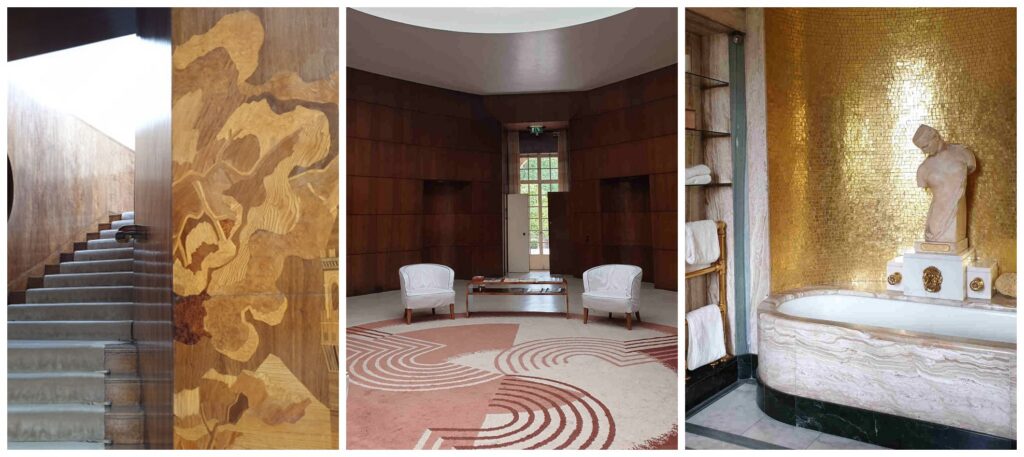
In the 14th century, Eltham was the most frequented royal bolthole in England, with Edward III and Henry VIII spending much of their childhoods here. Millionaires Stephen and Virginia Courtauld took over the property in 1933, and proceeded to modernise the house whilst trying to retain as many period features as possible. They installed mod-cons such as a centralised vacuuming system, underfloor heating, a loudspeaker system which could broadcast music to the ground floor and a private internal telephone system. The couple also kept a pet lemur, Mah-Jongg, a purchase from Harrods, who had his own quarters with underfloor heating.
The couple entertained royalty at their state-of-the-art home (Queen Mary visited twice) and held lavish parties for an eclectic group of friends such as the actress Gracie Fields.
Outside, you can wander around 19 acres of magnificent medieval and 20th century gardens. Eltham is one of the only 1930s gardens open to the public in Britain.
Flapper’s Delight
In the film, Gil and Inez are staying at Le Bristol Hotel in the chic fashion district of Paris.
When I think of Le Bristol in Paris, I always think of The Carlyle in New York and Claridge’s in London. The delightfully opulent Claridge’s is sometimes referred to as the annexe to Buckingham Palace. It’s been a home to politicians, royalty and Hollywood stars since it opened its doors in 1856. In the 1920s, the hotel was the go-to for the Bright Young Things, in 1945 Winston and Clementine Churchill moved in, and Spencer Tracy is quoted as saying: “…not that I intend to die, but when I do, I don’t want to go to heaven, I want to go to Claridge’s.”
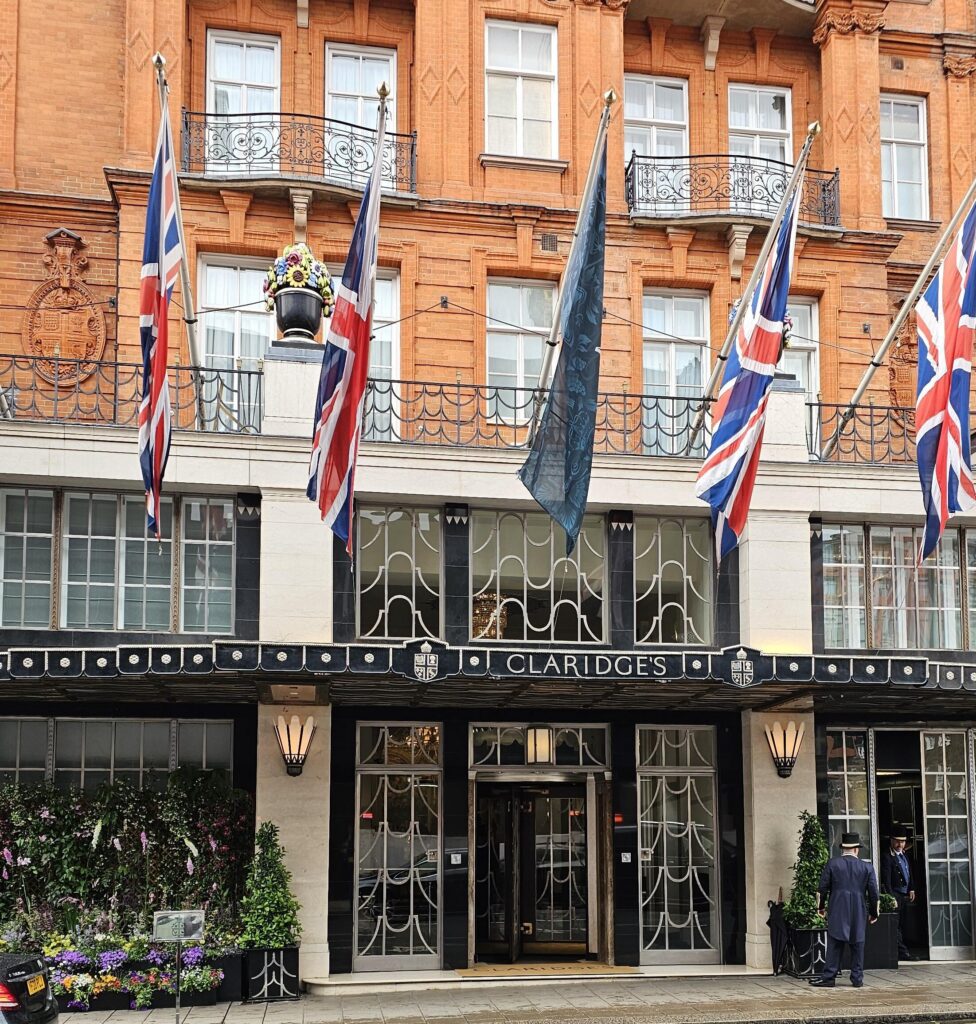
The hotel you see today was designed in the late nineteenth century by Harrods architect C. W. Stephens with such luxurious novelties as en-suite bathrooms, lifts and electric lights. The Art Deco touches such as the Lobby and Lalique door came later. The hotel bar is more twenty-first century, designed by my favourite designer, the late David Collins. Today, Claridge’s has the last man-operated lift in London. It also serves my favourite afternoon tea.
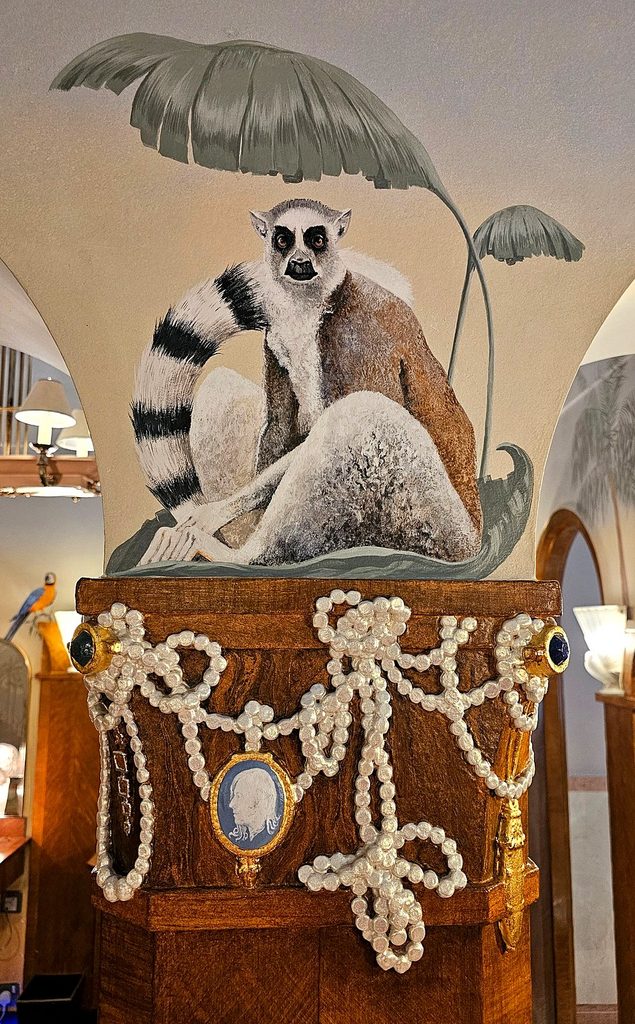
Fun fact: the Courtaulds’ pet lemur, Mah-Jongg, is hiding in plain sight at Claridge’s. See if you can spot him in the ladies’ toilets on the ground floor. The Courtaulds lived nearby in Grosvenor Square, so I like to think he was a regular long before he moved to Eltham.
A Vintage Classic
In the film, Gil and Inez have dinner with Inez’s ignoble parents in the Michelin-star restaurant Le Grand Véfour.
Let’s head over to Rules restaurant now for dinner, open for discerning diners since 1798 and London’s oldest eatery. Gil makes the faux pas of discussing politics with his would-be father-in-law, a staunch right-wing Thatcherite. Inez’s bombastic friend Paul walks in with his wife, Carol. He is spending a cultural summer in London whilst guest lecturing at the London School of Economics. They’ve just been to the exhibition “Traditional jewellery and dress from the Balkans” at the British Museum.
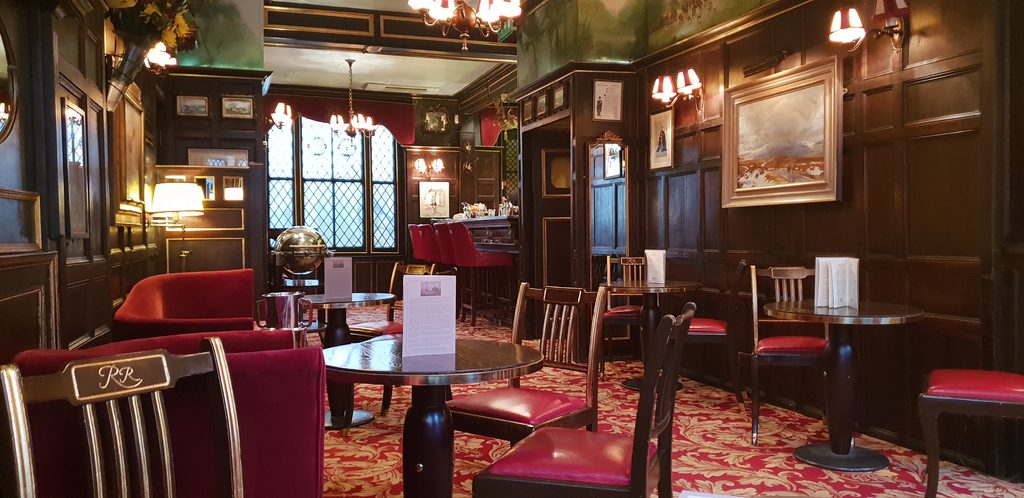
So what’s on the menu? Specialities of the house include their famous oysters, potted shrimp, steamed steak & kidney suet pudding, Welsh rarebit and Rules Golden Syrup sponge (with custard of course). You can wash all of this down with a Black Velvet (Guinness and champagne) or Kate Middleton’s “Royal 29” (gin, vodka, Lillet & crystallised violet petals).
Charles Dickens, H G Wells, Evelyn Waugh, Laurence Olivier, Clark Gable and Charlie Chaplin are only some of the patrons who dined in this star-studded restaurant. It’s made several appearances in Downton Abbey: Edith meets Michael Gregson for lunch here, and Mary, Edith and Tom take Rose for lunch to Rules before her wedding. Before you leave, climb the stairs to the Winter Gardens bar, once Edward VII’s private dining room, where rumour has it he entertained the actress Lillie Langtry.
Off with their Heads
In the film, Gil is coerced into spending the day at the Chateau de Versailles with Paul and Carol.
Heading south west from Claridge’s, past Harrods into Chelsea and then through Richmond Park, Gil and the terrible trio arrive in Hampton Court Palace, once home to notorious and deadly wife swapper Henry VIII. They wander around the Puzzle Maze and the spectacular Privy Garden whilst discussing Gil’s book, set in a nostalgia shop in Notting Hill.
The original manor house was acquired by the ill-fated Cardinal Wolsey who transformed it into a flashy palace. By 1528, Wolsey had fallen from the king’s grace, and Henry appropriated the bishop’s home for himself and his 6 queens, adding tennis courts, bowling alleys, pleasure gardens, a lavatory which could seat 28 people at the same time and the tapestry-clad medieval dining room, the Great Hall.
National Treasure
In the film, Gil, Inez, Paul and Carol visit the Musée Rodin in central Paris.
Let’s now head over to the Holborn area of London and to the John Soane Museum. I call this London’s House of Curiosities, and I know Gil would adore this place. Of course, Paul would be a walking Encyclopaedia Britannica about the inhabitants of 13 Lincoln’s Inn Fields as well as London architecture in general.
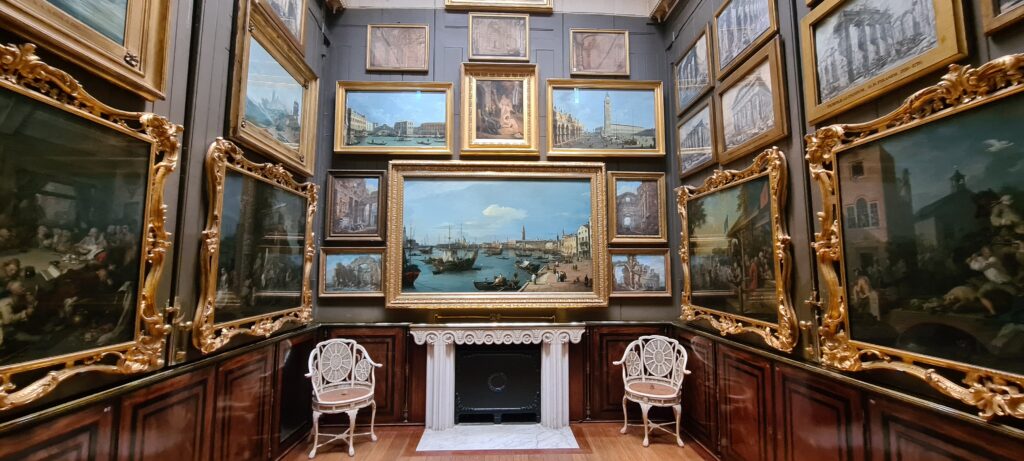
John Soane was one of the most influential and notable architects of his day, with the Dulwich Picture Gallery and the Bank of England also taking pride of place in his portfolio. Built in 1792, the museum was originally his home, and it now holds a treasure trove of over 6000 pieces, including the sarcophagus of Seti I and a selection of Canalettos and Turners.
My favourite nook in the museum is the Picture Room: secret walls conceal The Rake’s Progress, a series of 8 paintings by William Hogarth. The guide will fold these out and recount the tale of Tom Rakewell, a man who inherits money and squanders it all on prostitutes and gambling.
It’s Gin O’Clock
In the film, Gil attends a wine-tasting event with Paul, Carol and Inez’s parents on the roof terrace of Le Meurice Hotel. Frustrated with the group, he decides to head off into Paris for a late walk.
Our social get-together isn’t an al-fresco one but takes place in the Soho Bar of the Groucho Club in Soho. It’s an exclusive members’ club for media and theatrical types, actors, artists, eccentrics and the odd backgammon player. I organised my husband’s 40th here, and let’s just say it was a night to remember.
The name is a play on Groucho who is misquoted as saying: “Please accept my resignation. I don’t want to belong to any club that will accept me as a member.” The club has an impressive art collection and a maze of rooms, all of which swell as the day runs into night with party revellers. And yet, the Groucho feels strangely intimate: it’s the sort of place where everyone knows your name, where you can really let your hair down.
So who might Gil bump into at The Groucho? I couldn’t possibly comment.
The Witching Hour
In the film, Gil is lost and stops for a rest on the steps of the church of St Etienne du Mont. At the stroke of midnight, a vintage Peugeot drives up with a group of revellers dressed in 1920s clothes. He gets in.
Gil leaves the Groucho Club for a walkabout in bustling Soho and then heads back to Claridge’s. He stops for a rest in Hanover Square on the steps of St George’s Church.
St George’s has been a Mayfair landmark since 1725. Handel had his own pew in the church and Theodore Roosevelt married here (the only American President to marry outside the USA). In My Fair Lady, Alfred Doolittle invites his daughter Eliza to his wedding at St George’s, scene of the famous song Get Me to the Church on Time!
Anything Goes
Ensconced in a peacock blue Rolls Royce Silver Ghost, a young man beckons Gil to join him in the car and swiftly hands him a Martini glass. The man is wearing teal silk pyjamas and a white fur cape. There are two women in the car, both dressed in men’s midnight blue tuxedos.
I Went to a Marvellous Party
In the film, the car takes Gil to a party where Zelda and Scott Fitzgerald are dancing and Cole Porter is at the piano.
Our Rolls Royce sweeps Gil off to a Mayfair party in full swing. The Bright Young Things of the 1920s are here: fancy dress, treasure hunts and cocktails until dawn. At the piano is the dapper Noël Coward, who later wrote I Went to a Marvellous Party about exactly this sort of glittering social whirl.
In the film, Gil asks Gertrude Stein to read his novel. Our Gertrude is Virginia Woolf, whose Bloomsbury salon sits a short ride away. She reads his manuscript about a nostalgia shop in Notting Hill and tells him to stop looking back and write about the present.
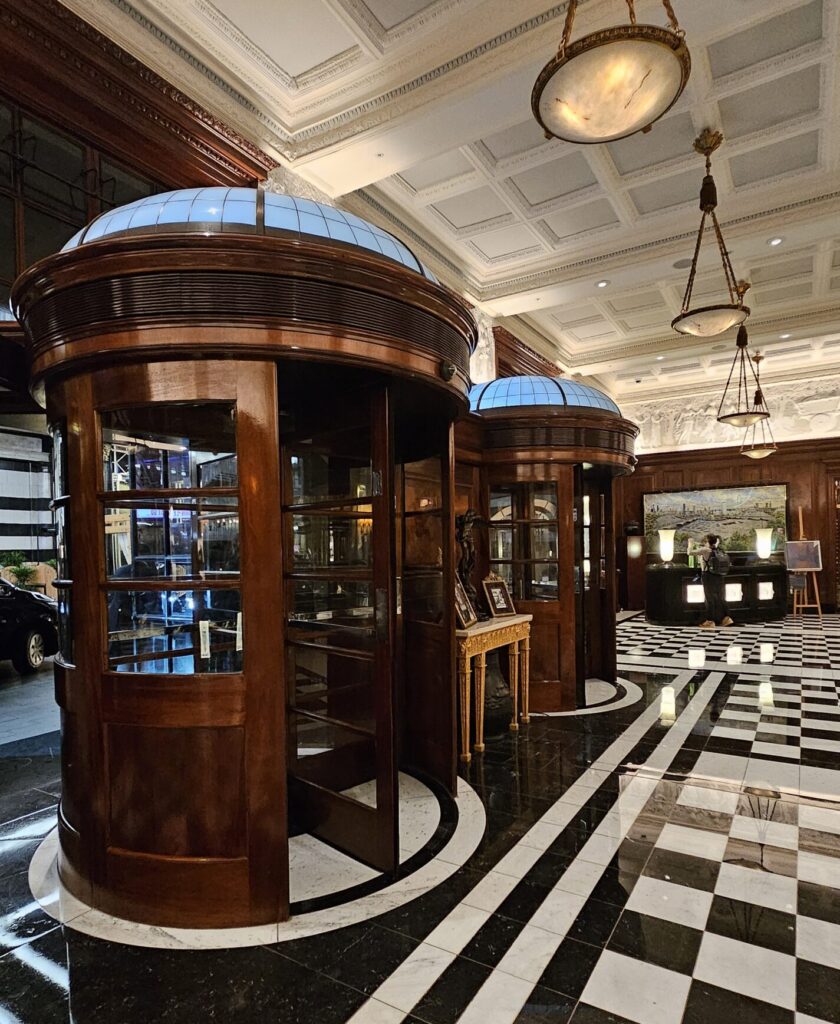
When the party finally winks out, the night moves on to The Savoy where the dance bands of the 1920s kept London dancing until the small hours and Noël Coward was a frequent guest. Gil slips into the American Bar for a cocktail, and the pianist is playing as if the night will never end.
The Green Hour
In the film, Gil and Adriana take a horse-drawn carriage into the Belle Époque and dine at Maxim’s, where they meet Toulouse-Lautrec, Degas and Gauguin. Adriana decides she would rather stay than return to the 1920s.
Our carriage clatters back much further, to Victorian London and Regent Street, and the glittering Café Royal. It was opened in 1865 by a French wine merchant who had fled Paris with five pounds in his pocket, and by the 1890s it was the place to see and be seen. A piano is playing, the champagne is flowing and the room is in full, glittering swing.
At his usual table in the corner, a green carnation in his buttonhole and a glass of absinthe in front of him, sits Oscar Wilde, holding court. George Bernard Shaw and Max Beerbohm are in the audience, hanging on every word. (Today the hotel’s Green Bar still nods to Wilde and his fondness for absinthe.)
Here Gil makes the discovery at the heart of the film: the golden age is always the one before. As Wilde wrote in Lady Windermere’s Fan: “We are all in the gutter, but some of us are looking at the stars.” Every generation looks back and thinks the past was better, so the present is the only place worth living in.
Singing in the Rain
In the film, Gil leaves Inez, meets Gabrielle, who sells vintage records at a flea market, and they walk off together in the rain on the Pont Alexandre III.
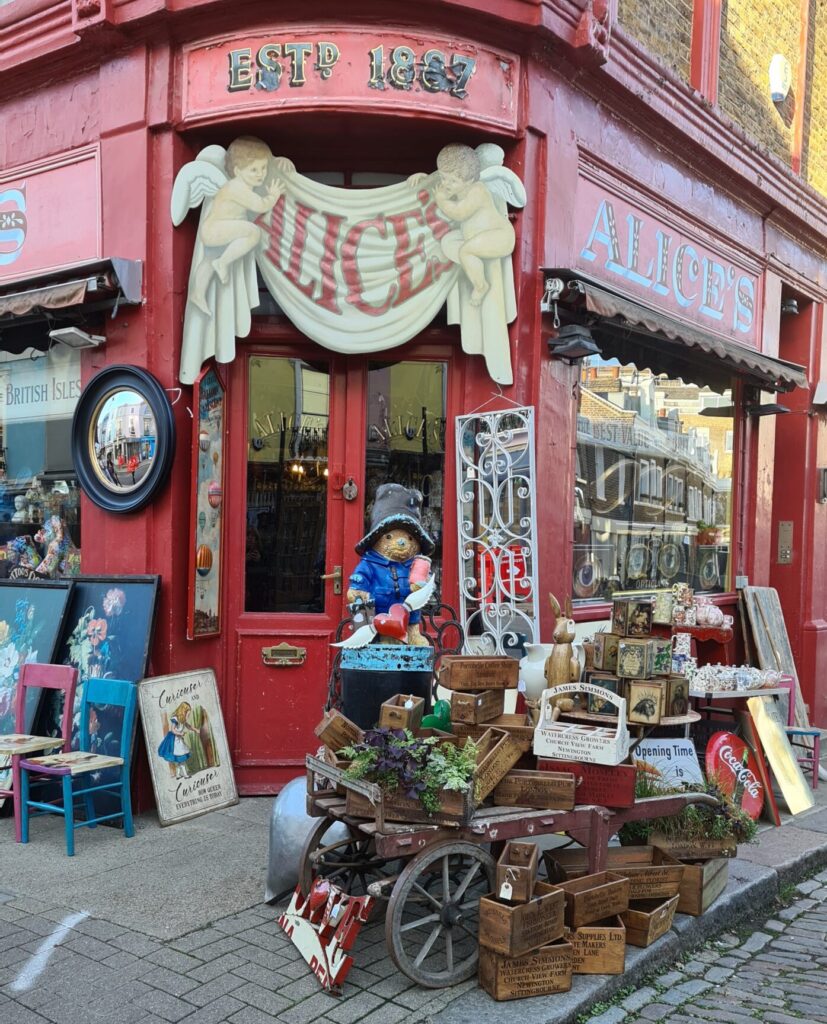
Back in the present, Gil tells Inez it is over and stays on in London. He wanders along Portobello Road, where a stallholder sells him a vintage record, and they fall into conversation about the golden ages they would like to have lived in. As the rain starts to fall, they walk across Waterloo Bridge, nicknamed the Ladies’ Bridge, with the Thames at their feet and the whole of London lit up in front of them. And Gil, at last, is happy exactly where he is.
Sources: Wikipedia, IMDb and books. First written in 2017. Opening times, prices and menus change, so please check the venue’s own website before you visit.