Chances are, you’ve never heard of the Berners Street Hoax, one of the world’s biggest pranks and one which brought Georgian London to a virtual standstill. Concocted by Theodore Hook, a celebrity of the time, it was designed to show that any old London house could become the most talked-about address in town within a week.
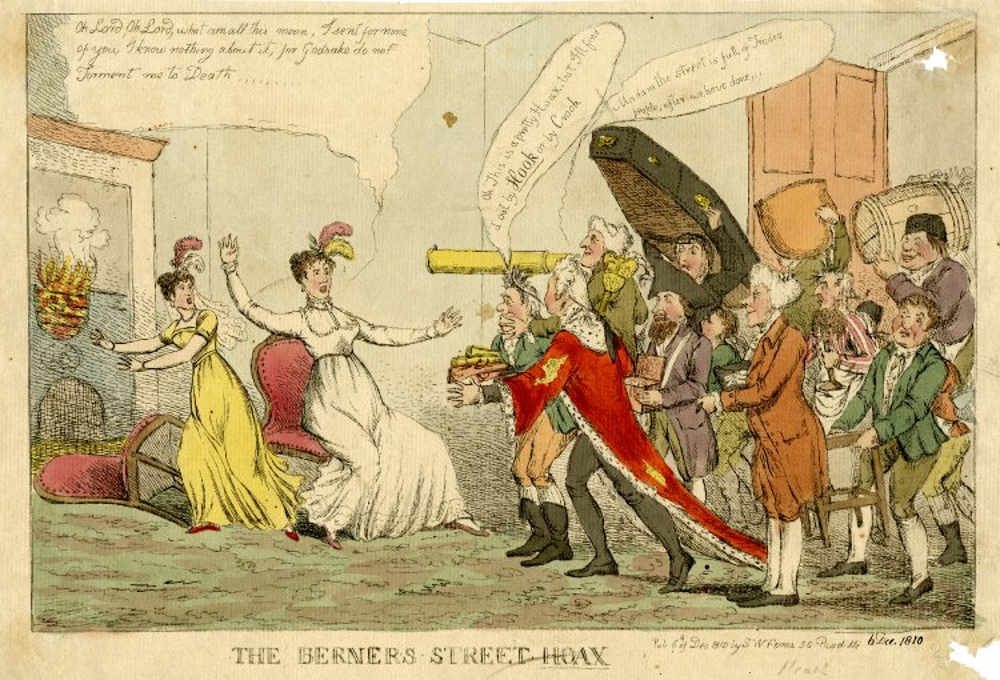
The Berners Street Hoax, a Georgian caricature (public domain)
The Berners Street Hoax of 1809
Theodore Hook placed the bet with his chum Samuel Beazley, also a well-known figure, for the grand sum of a guinea. The set-up took place on 27 November 1809 at 54 Berners Street, a hop, skip and a jump from Oxford Street. It happened to a poor Mrs Tottenham, a well-to-do widow who was probably minding her own business.
Hook had previously sent out thousands of letters to businesses and individuals around London, inviting them to deliver their wares to 54 Berners Street on the morning of the hoax.
In the early hours the games began. A chimney sweep came knocking at Mrs Tottenham’s door, claiming his services had been ordered by Mrs Tottenham. He was followed by 12 more. The deliveries then started: coal from Paddington wharf, potatoes, wedding cakes, books, ices, jellies and, it is said, 2,500 raspberry tarts ordered from 50 pastry cooks. Further deliveries included a church organ, several pianos, a made-to-measure coffin and mourning coaches.
Lawyers, doctors, nurses, hairdressers, milliners, fishmongers, barbers and artists arrived on her doorstep. Auctioneers, accoucheurs, tooth drawers, poultry and pigeon sellers also formed part of this extraordinary cacophony.
Members of Parliament came knocking, together with the Lord Mayor, who was responding to a request from the “deathbed of a penitent councilman”. Hook also sent letters to the Governor of the Bank of England, the Chairman of the East India Company, the Duke of York and the Archbishop of Canterbury.
Examples of the letters sent to Mrs Tottenham included:
“Mrs Tottenham requests Mr ———- will call upon her at two to morrow as she wishes to consult him about the sale of an estate —– 54 Berners street Monday”
“Mrs Tottenham requests that a post chaise and four may be at her house at two to morrow to convey her to the first stage towards Bath —– 54 Berners street Monday”
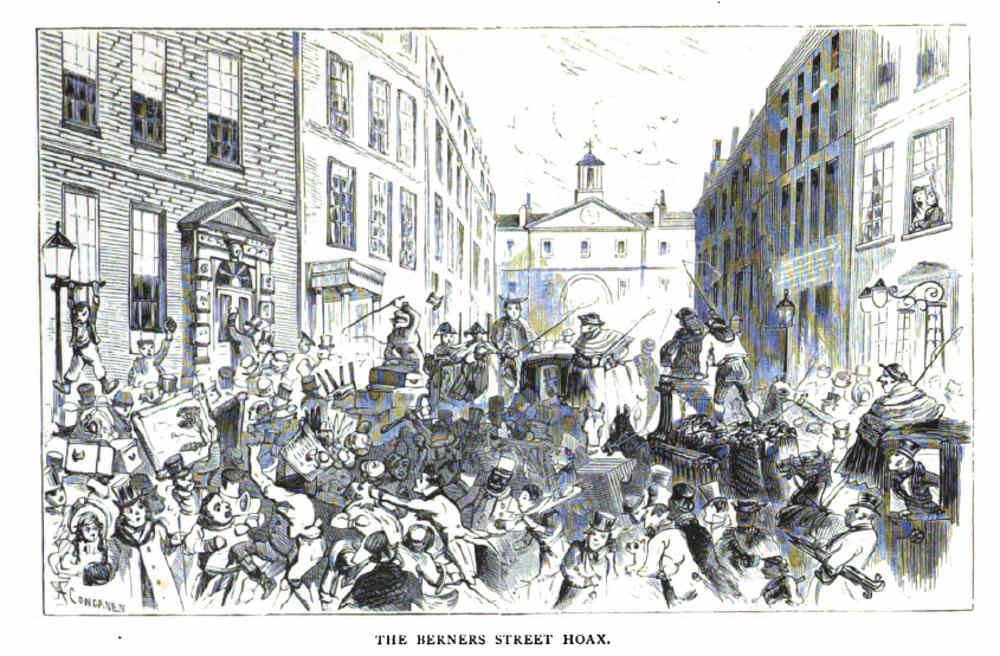
Image: British Newspaper Archive
Hook, Beazley and friends rented rooms opposite No 54 so that they could watch the parade of tradesmen arrive. Berners Street became a hazardous quagmire of carts, wagons, people and fare. Breakables, carriages and carts were smashed in the melee, beer and wine barrels were overturned, and utter chaos ensued. The traffic jam grew from one end of Oxford Street to the other and into its ancillary roads.
The roaring crowds called for the capture of the perpetrator, but friends of Hook’s who were in attendance kept schtum. Officers from the Marlborough Street police station were despatched to the scene, but to no avail. On arrival, they were greeted by “six stout men bearing an organ, surrounded by wine porters with permits, barbers with wigs, manufacturers with band boxes, opticians with their various articles of trade… at four o’clock all was still in confusion.” (The Annual Register)
Hook got away with the Berners Street Hoax, one of the biggest hoaxes in British history, by absconding to the country for a few weeks.
The Berners Street Hoax perpetrators
Theodore Hook
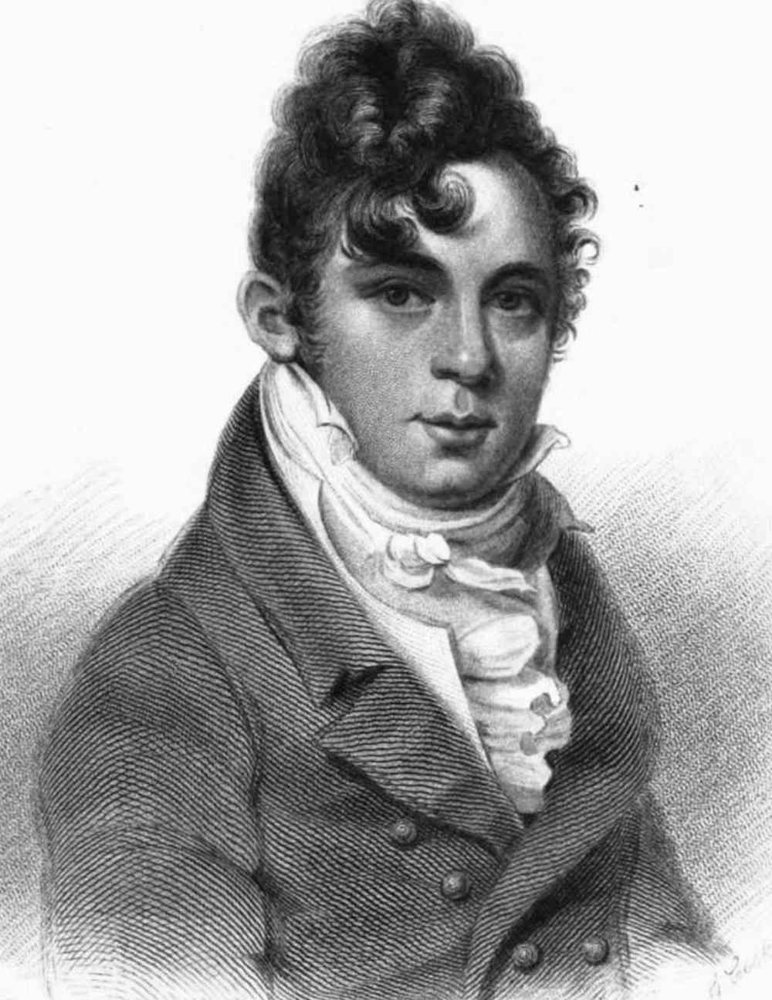
Theodore Hook (public domain)
Theodore Hook was born in Charlotte Street in London. He was a Regency playboy, writer, wit, composer and joker, and one of the celebrities of the Georgian age. He is said to have posted the world’s first picture postcard, to himself, and he is thought to be the inspiration behind Mr Wagg in Thackeray’s Vanity Fair and Lucian Gay in Disraeli’s Coningsby.
He was the son of the composer James Hook and grew up writing words for his father’s operas. The Prince Regent made him Accountant General of Mauritius, where he was arrested over missing funds in 1817. Back in Britain, he went on to found John Bull, a popular Sunday newspaper that closed in 1964.
Hook was one of the country’s bestselling novelists. He was a member of the “silver-fork” school, famous for fashionable novels in which members of the English upper class penned comedies of errors about the same class (think Lady Whistledown in Bridgerton). He died at his home in Fulham, aged 52.
Samuel Beazley
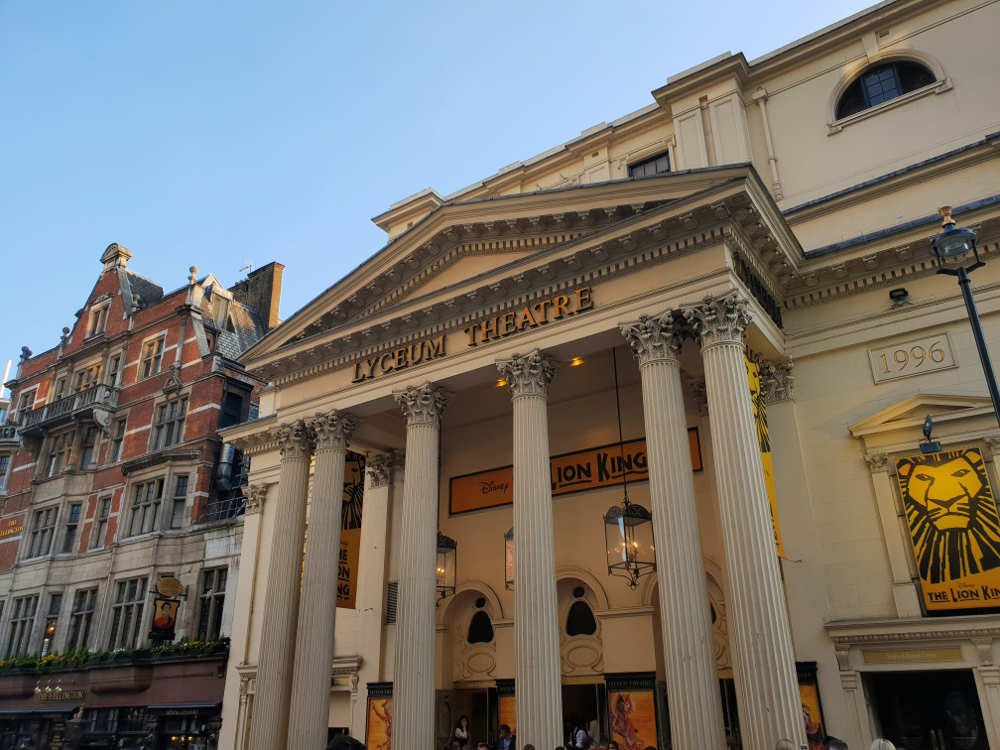
The Lyceum Theatre, designed by Samuel Beazley
Samuel Beazley was a novelist and playwright and one of the leading theatre architects of the Georgian era. His credits include the Lyceum Theatre and the now defunct St James’s and Royalty theatres. He was also asked to undertake major renovation works at the Adelphi and Drury Lane theatres, which still exist today.
Berners Street today
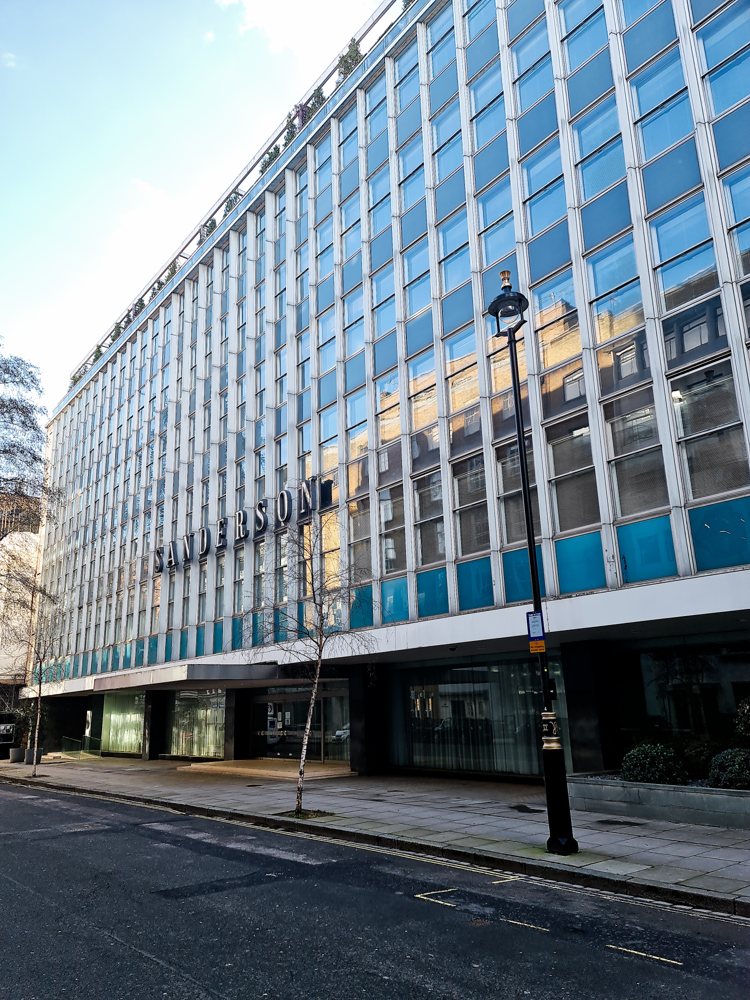
Berners Street is now home to the splashy Sanderson Hotel, which stands on the stretch of street where No 54 and the Berners Street Hoax once played out. The street has strong associations with Charles Dickens. His mistress, Ellen Ternan, lived at No 31, and the street is also said to have inspired one of his greatest characters, Miss Havisham, the “conceited old creature, cold and formal in manner… dressed entirely in white”. Samuel Taylor Coleridge is said to have lodged at No 71.
For more famous Londoners, read about A. A. Milne and Richard D’Oyly Carte.
Sources: The Annual Register; The British Newspaper Archive; The Baltimore Repertory of Papers on Literary and Other Topics.